News · Research4 min read
Game-based learning in medical education: an attending-run card game lifted resident engagement on rounds
Game-based learning in medical education now has randomized-trial data from hospital rounds, and on 25 September 2026 the AMA brought it to residents nationwide. In a 22-week study at Jefferson Health in Philadelphia, internal medicine residents who played Round34, a cooperative card game moderated by the attending physician during teaching rounds, rated rounds higher for educational value (8.0 vs 6.2 on a 10-point scale), engagement (8.5 vs 7.1) and comfort asking questions (9.1 vs 8.2), and the study found no difference in rounding time. The paper appeared in February 2026 in the Journal of Graduate Medical Education (2026;18(1):43–50).
Founding membership is free. Apply in about two minutes and get a numbered certificate with a public verification link the minute you apply.
What the Round34 study found
Game teams scored rounds higher on all three primary outcomes (each P<.0001), with no added rounding time.
Paired inpatient internal medicine teams at one academic center were randomized in 2024 to play Round34 during teaching rounds or to round as usual. After adjusting for patient volume, call days and round duration, gameplay stayed independently associated with the better scores (Baig et al., JGME 2026).
| Outcome (resident self-report) | Game teams | Standard rounds | Result |
|---|---|---|---|
| Perceived educational value of rounds | 8.0 | 6.2 | Higher, P<.0001 |
| Engagement during rounds | 8.5 | 7.1 | Higher, P<.0001 |
| Comfort asking questions | 9.1 | 8.2 | Higher, P<.0001 |
| Rounding time | Recorded daily | No difference found | |
| Burnout, well-being, loneliness | Weekly validated scales | No difference found | |
Data: 274 of 455 daily and 54 of 91 weekly responses (PubMed 41694777).
How the game fits into rounds
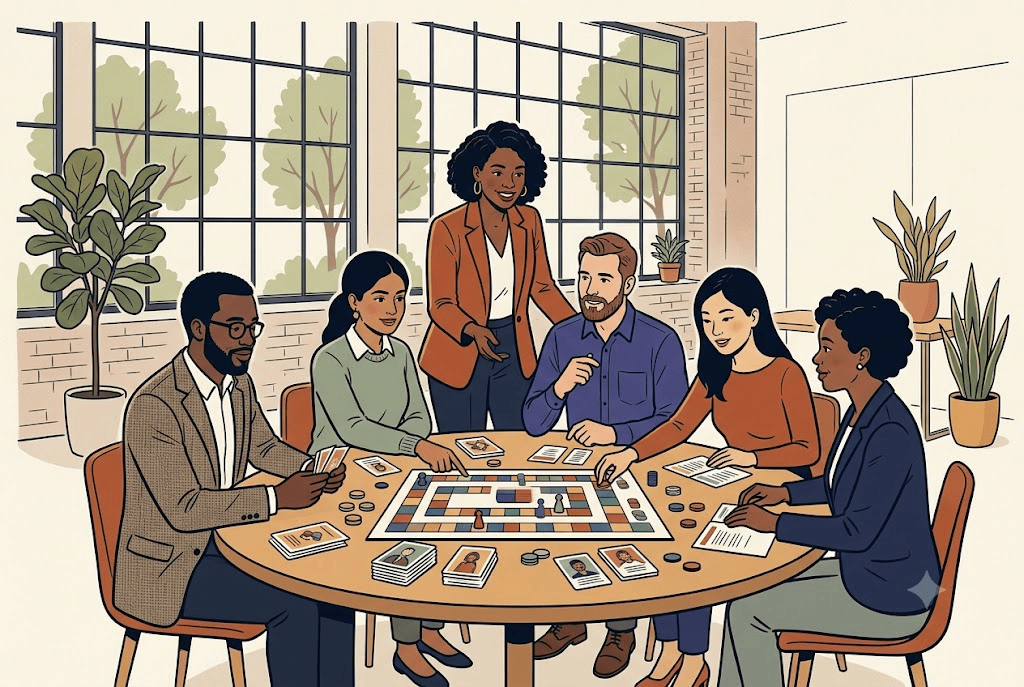
Round34 is an investigator-developed cooperative card game played during teaching rounds, with prompts that range from humor to clinical questions.
Pulmonologist Saqib Baig, MD, MS, and Vincent Chan, MD, built it for two problems the paper names: high team turnover and hierarchical dynamics that limit engagement and comfort asking questions. Dr. Baig told the AMA:
“This game can help lower the initial barrier that people might feel when they start on a team.”Saqib Baig, MD, MS, to the AMA
Why the facilitator matters in this design
The study's own title calls the method “attending-moderated tabletop gameplay”: the attending physician runs the game.
A card deck on its own is a set of prompts. Someone has to choose the moment, keep the pace, make it safe for the junior-most person to speak, and tie answers back to clinical learning. In our reading, those are the core tasks of a game facilitator, done here by a physician during clinical work. Facilitators who run short games with new corporate teams can share session designs of this kind in our Team Building hub.
What this means for L&D, medical educators and game authors
- L&D and GME leaders: treat a facilitated game as a measurable team-dynamics tool. Copy Round34's design (daily 10-point surveys, recorded rounding time) when you pilot a game, and brief whoever runs it on what a game facilitator actually does.
- Game authors and publishers: a published trial with daily measures sets a clear bar for evidence. Bring your game to the Educational Games or Team Building hub to compare session designs and outcomes.
- Facilitators: founding members help define the competencies behind the game facilitator certification framework now being drafted.
Limits worth knowing
This is one trial at one center, with self-reported outcomes.
Response rates were about 60% (274 of 455 daily and 54 of 91 weekly surveys). The study found no differences in burnout, well-being or loneliness, so the measured gains concern the learning climate of rounds.
FAQ
What is Round34?
An attending-moderated cooperative card game for inpatient teaching rounds, developed by physicians at Jefferson Health.
Does a card game make hospital rounds longer?
In the 22-week randomized study (JGME, 2026), researchers found no difference in rounding time between game and control teams.
Does game-based learning reduce resident burnout?
In this study, weekly surveys found no differences in burnout, well-being or loneliness between groups. The gains were in educational value, engagement and comfort asking questions.
Who should facilitate a serious game with clinical or corporate teams?
Someone trained to run and debrief games; in Round34 it was the attending physician. The association's Global Directory, coming soon, will let organizations find and verify facilitators.
- Free application, about two minutes, numbered certificate issued instantly
- First listing in the Global Directory when it opens, in member-number order
- A seat in the working group writing the certification standard
Sources: Baig S, Dong MQ, Sirapu S, Chan V. J Grad Med Educ. 2026;18(1):43–50; AMA, 25 September 2026.