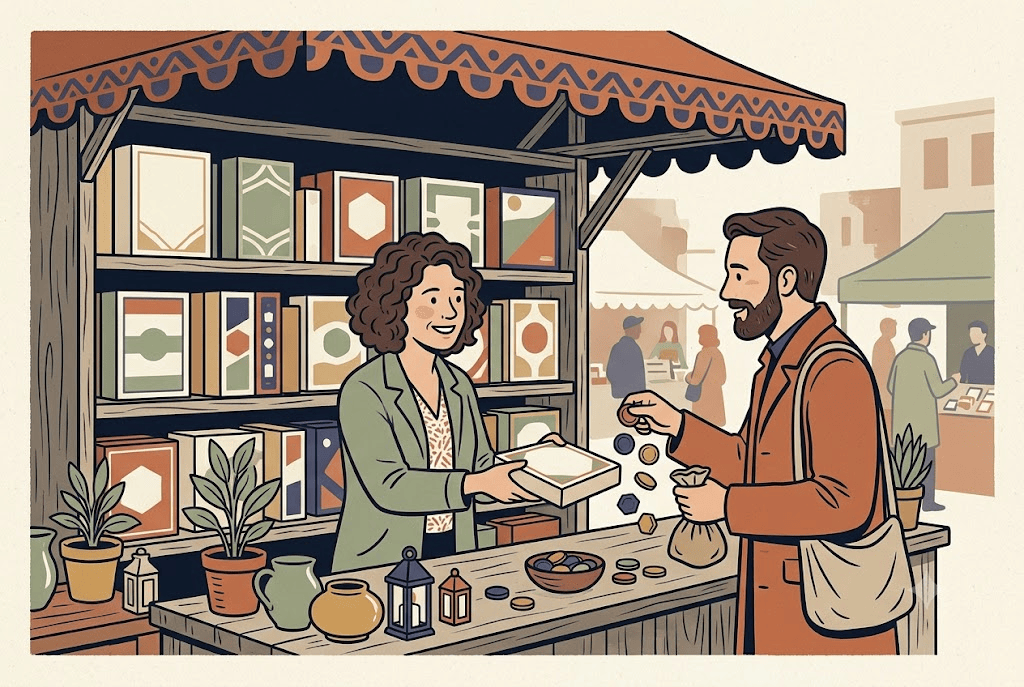
What it will be
Status: coming soon — designed and tested with the founding cohort before it opens.
Game authors and publishers currently sell through personal websites, PDFs over email and handshake licensing. The Marketplace gives the profession a proper storefront: physical games, print-and-play editions, facilitator licenses, training programs, card decks and more — discoverable by the practitioners who actually run them.
What makes it different is respect for the work. Every game carries declared authorship and IP status, and licensing is first-class: personal use, facilitator, trainer, school, corporate-internal and translation rights are distinct things you can actually buy — not a paragraph of small print everyone ignores.
What you'll be able to do
List physical games, print-and-play editions, licenses, training programs, card decks and resources.
Six license types — from personal use to trainer, school, corporate-internal and translation rights.
Owned, co-authored, licensed or public domain — IP status is on the record for every game.
Browse by hub — transformational, business, educational, therapeutic and beyond.
Sell to verified facilitators worldwide, not to whoever stumbles onto your site.
Already in the foundation
This page describes something in formation — but not something imaginary. The platform runs on one canonical data model, and this product is already part of it, behind a feature flag.
Games and authorship are modeled. Game and co-author records with explicit IP status (owned / co-authored / licensed / public domain) exist in the canonical schema.
The licensing taxonomy exists. All six license types are modeled today — the legal shape of the marketplace precedes the storefront.
Ten listing types, real orders. From physical games to AI prompt packs and research reports; order and license records handle money as integer cents, properly.
Flag-gated, not vaporware. The marketplace ships by switching a feature flag on the live platform — the data model is already in production.